News :From Sphinxes to Songbirds: Victorian Poster Trail
News Story
As part of Heritage Open Day 2026, we invite you to discover our extraordinary 19th‑century past through original theatrical posters. Explore magic, music, impersonation, and Victorian spectacle in a self‑guided trail revealing the performers who once wowed Hemel Hempstead. This free trail is most impactful in person, but if you can't make it into the theatre, it can also be enjoyed right here, online.
11, 14, 16, & 18 Sept. 2026: 11am-5pm
12 Sept. 2026: 12noon-5pm
(not open 13 & 15 Sept.)
Step inside The Old Town Hall and stroll back to the mid‑1800s, when this very building was alive with magical tricks, musical marvels, daring impersonators, and performers who travelled the world before arriving right here in Hemel Hempstead. Each of the historical posters around the venue reveals a snapshot of the extraordinary entertainment our Victorian audiences once enjoyed.
These posters are more than advertisements — they are windows into the lives, talents, and imaginations of the people who shaped The Old Town Hall’s story. As you wander through the building, take a moment to picture the gasps, laughter, applause, and wonder that once filled these rooms.
Alfred Stodare: Magic, Mystery, & a Family Feud
Dated: 1st & 2nd October (year unknown)
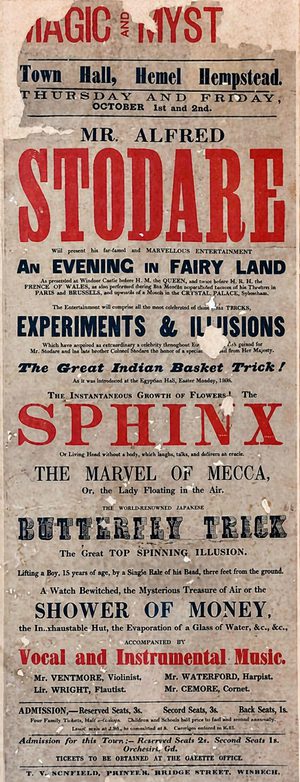
This striking poster features Alfred Stodare and his celebrated show An Evening in Fairyland — a performance he once presented to Queen Victoria, Prince Albert, and the future King Edward VII. But behind the magic was real‑life drama: Alfred had adopted the stage name of his brother, Colonel Stodare, causing a rift that never healed.
Colonel Stodare was famous for The Sphinx, an illusion performed at London’s Egyptian Hall. Imagine the shock of Victorian audiences as a disembodied Egyptian head opened its eyes, smiled, answered questions… and then crumbled into dust. The poster here proudly advertises that very trick.
You will also spot references to the Great Indian Basket Trick, where an assistant climbed into a wicker basket only to “vanish” while swords pierced through it. Victorian audiences adored the suspense — and performers like Stodare added dramatic lighting, sound effects, and storytelling to heighten the thrill.
Several of the other illusions mentioned do not appear in surviving primary descriptions of Stodare’s repertoire, however we can make the following inferences given the era and his known staging methods (mirrors, trapdoors, concealed assistants).
- The Marvel of Mecca, or the Lady Floating in the Air - this illusion was likely a variant of the classic “suspension” or “levitation” using concealed supports or angled mirrors.
- The World-Renowned Japanese Butterfly Trick – a paper-butterfly juggling illusion, whereby a handheld fan was used to keep the faux butterflies in the air; often real butterflies were released at the end of the trick.
- The Great Top Spinning Illusion: Lifting a Boy, 15 years of age, by a Single Hair of his Head, three feet from the ground – sounds painful, but is likely a publicity exaggeration, or a miscopied description. Illusions of this type were documented at the time involving the performers themselves (usually acrobats) being lifted or swung by a specially reinforced hairpiece.
- The Shower of Money / The Inexhaustible Hat – a classic production effect where coins or other objects appear endlessly from an empty space / hat.
Stodare’s act was accompanied by four live musicians and vocalists. Much like The Old Town Hall’s ticket prices today, the prices for Stodare’s act were competitive, and exactly what customers of the time would expect to pay for a magician with a strong reputation, performing in a fashionable venue. The pricing was solidly middle-class and designed to attract families; in modern terms Stodare’s prices equated to £15 - £40 per ticket, depending on where you sat in the theatre.
Professor Oliver: The Merry Magician
Dated: Unknown
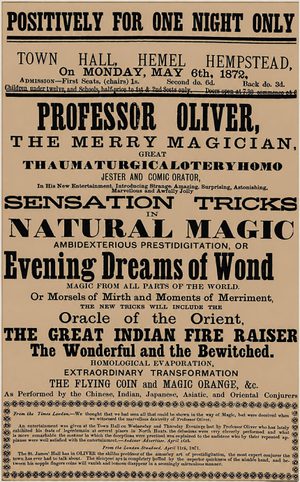
This poster introduces Professor Oliver, described with glorious Victorian flair as the “Great Thaumaturgicalotteryhomo, jester and Comic Orator!” His act blended humour, sleight‑of‑hand, and international magic traditions.
One newspaper story tells of Oliver visiting Basingstoke Market, cracking open eggs, and producing gold sovereigns — much to the horror (and later disappointment) of the egg seller who tried to find more “golden deposits” in her basket.
Oliver’s repertoire included the Flying Coin Trick and the famous Magic Orange Trick, where a spectator’s chosen card appeared inside an orange. The poster hints at a night of clever illusions that left audiences delighted and mystified.
Basil Rivers: Fifteen Characters, One Performer
Dated: Thursday 14th November 1871
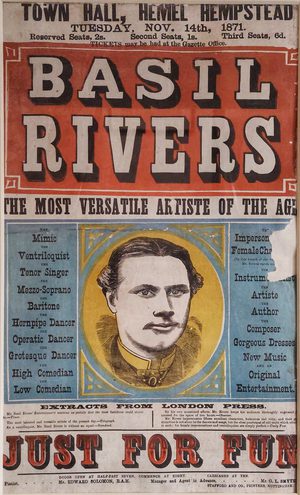
On 14 November 1871, Basil Rivers took to our stage — a celebrated female impersonator who performed fifteen different characters in one evening. Think less modern drag queen and more pantomime dame: comic, expressive, and full of personality.
Victorian audiences loved these acts, but attitudes were complicated. While performers like Rivers were celebrated, ordinary men dressing in women’s clothing could face arrest — as shown by the sensational Bow Street case of Ernest Boulton and Frederick Park, who appeared in court in full satin gowns to the shock (and amusement) of the public.
Rivers did not stop at impersonation. He was also a grotesque dancer — a comic, exaggerated style of movement — and a ventriloquist at a time when ventriloquism involved “throwing” voices around the room rather than using puppets.
Our poster proudly calls Rivers “The Most Versatile Artiste of the Age,” and it is easy to see why.
Emma Stanley: The Seven Ages of Woman
Dated: Friday 28th April 1871
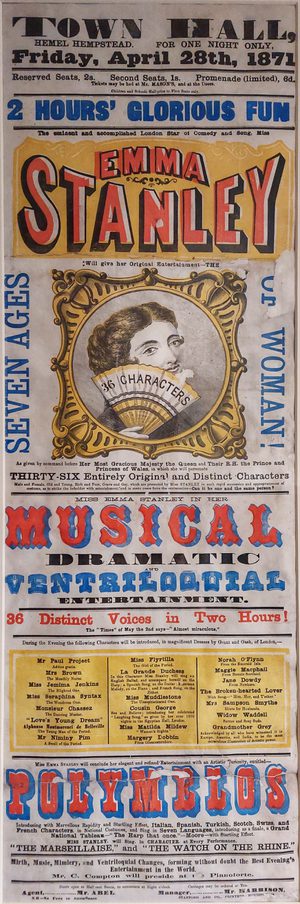
For two hours Miss Emma Stanley transformed into thirty six distinct characters — young, old, male, female, comic, romantic, and dramatic. Each character involved instant costume changes, and Emma switched voice, posture, dialect, and mannerisms with astonishing speed. Her humour relied on Victorian social stereotypes that were delivered with warmth rather than cruelty. Examples of her trademark characters were:
- Miss Seraphina Syntax – a pedantic bluestocking; satire of the Victorian female intellectual, portrayed as overly earnest, verbose, and socially awkward.
- Mr Nimmy Pim – a foppish young gentleman who was a classic “dandy” or “swell” obsessed with appearance, etiquette, and flirtation.
- Widow Waddell – a chatty, emotional, and overbearing older woman who alternated between tears and laughter.
Reviews from around the world praised her talent:
- “Faithful copies from life” — Boston Ledger;
- “The most decided theatrical success we have witnessed” — The Melbourne Argus;
- “As talented as they represent her to be” — The Calcutta Englishman.
Victorian audiences squeezed into theatres to see her astonishing quick‑change artistry. As you look at her poster, imagine the gasps as she shifted from a love‑struck teenager to a wheezy old man, to a strutting officer — all in moments.
Stanley concluded her act with an artistic curiosity “Polymelos”, or many musical characters. It was a sequence of rapid transformations, each representing a different musician. Reviews describe her switching instruments, changing costume, altering posture and facial expressions, shifting between national or regional music styles, and imitating musical types with astonishing speed. Examples are:
- The Italian Street Musician – playing the organ or mandolin;
- The Scottish Bagpiper – wearing a tartan shawl and using an exaggerated drone;
- The German Bandsman – stiff posture playing a brass instrument.
Emma Stanley’s act was performed before Queen Victoria and the Prince and Princess of Wales at Marlborough House in London in April 1871, hence the Royal command referenced on the poster.
The Greenhead Family: Eight Siblings, Endless Talent
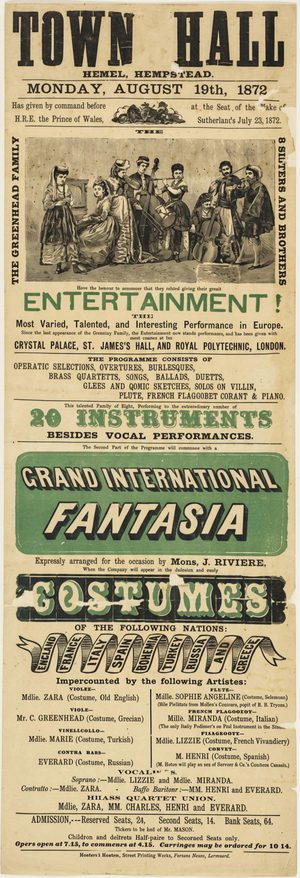
Dated: Monday 19th August 1872
The Greenhead Family performed here just one month after their performance before HRH the Prince of Wales at the seat of the Duke of Sutherlands. The Greenheads were a troupe of eight siblings known for their musical skill and theatrical flair, singing and performing on twenty instruments. Their shows were an eclectic mix of operatic selections, burlesques, brass quartets, comic sketches, and more.
One highlight advertised on the poster is an “International Fantasia” arranged by French composer Jules Riviere, who later became a celebrated musical director in Wales and helped pioneer seaside promenade concerts. It seems a little unusual today for the “elaborate and costly” costumes of various nations to be highlighted on the poster, alongside the artistes who were impersonating them:
- On violin, Mdlle. Zara in Old English costume;
- On pianoforte, Mdlle. Lizzie in French Vivandiere costume;
- On one of Hawkes and Co. Excelsior Cornets, M. Henri in Spanish costume.
Carriages were to be ordered for 10:15pm, probably due to the Greenheads’ extensive set list! Victorian audiences in Hemel Hempstead described the show as a “rare treat", and this poster reflects the pride of hosting such a talented family ensemble.
Amateur Concerts & Community Spirit
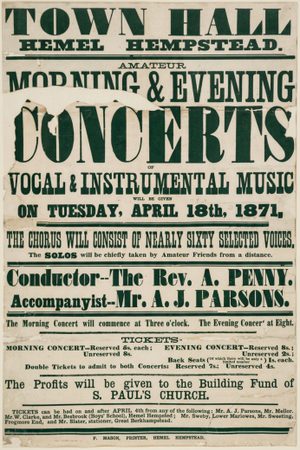
Dated: Tuesday 18th April 1871
Not all performances were professional. This poster advertises an amateur concert raising funds for St Paul’s Church — a reminder of how deeply the Town Hall was woven into local life. These amateur musicians worked hard with a two-show day – it is interesting to note that the evening performance started at 8pm, as do many of The Old Town Hall’s comedy and theatrical performances today. Given the price it seems that tickets to the “morning” concert must have been slightly more sought after; as this is a fundraiser ticket prices were more expensive than some of the other acts featured on our posters. At two shillings, the cheapest tickets were the equivalent to purchasing three to four loaves of bread, right up to the most expensive tickets costing seven shillings, which could equate to most of a week’s rent for a poorer family in the area.
These musical concerts were accompanied by a chorus of nearly sixty voices; interestingly note the phrase – “The solos will be chiefly taken by Amateur Friends from a distance” – meaning that competent, socially connected amateur vocalists were travelling from other towns to perform the solo parts. This would have been an important fact for the Victorian audience of the time, who cared deeply about who was performing.
St Paul’s, built by public subscription, stood on Queen Street (now Queensway) and served the community for nearly a century. The conductor of the concert was the Reverend Alfred Penny, a Church of England clergyman serving St Paul’s Church, who was responsible for parish music, fundraising, and community events. Many of the clergy at this time were trained in harmony and part-singing, so Rev. Penny would have been musically literate, well-liked, and trusted locally, hence the “Amateur friends from a distance”. This poster reflects a time when music, morality, and community fundraising were intricately linked.
Christmas at The Old Town Hall: A Long‑Loved Tradition
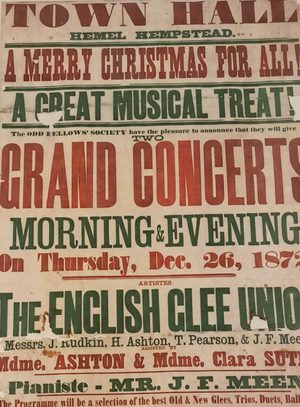
Dated: Boxing Day, Thursday 26th December 1872
Christmas has always been special here. On Boxing Day 1872, The English Glee Union performed two festive concerts — just one year after Boxing Day became an official bank holiday.
A “glee” was a short a cappella part-song, usually sung by three or four male voices and based on English poetry. The English Glee Union was a touring association of trained amateur and semi-professional male singers who travelled to provincial towns for concerts. By the 1870s, glees were declining in popularity, so the English Glee Union were preserving a fading musical tradition and providing a connection to London’s musical culture. We do not know the exact repertoire of this concert, but it would have likely featured:
- Classic glees by canonical composers, such as The Chough and Crow, or Hark the Lark;
- Seasonal carols arranged for male voices, like God Rest Ye Merry Gentlemen, or The Wassail Song;
- A comic glee, like The Miller’s Daughter;
- A finale of Glorious Apollo.